Timed to Think: How Your Brain's Biological Clocks Determine When You Learn, Create, and Perform Best
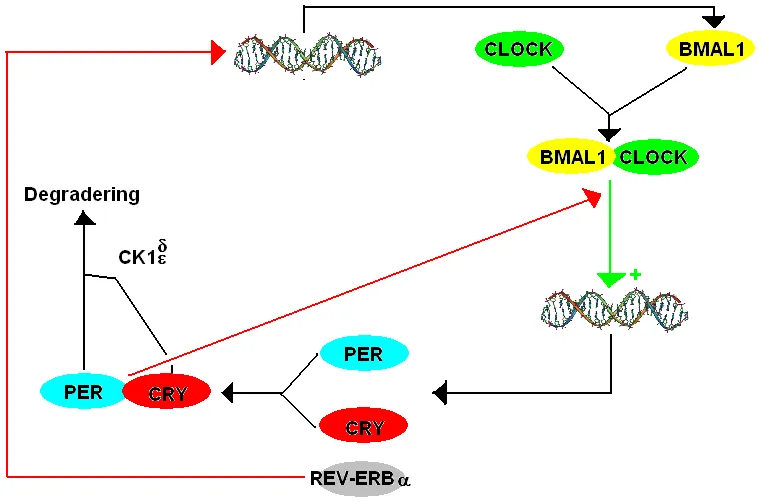
Photo: Nitramus, CC BY-SA 3.0, via Wikimedia Commons
Most Americans approach the workday as though the brain is a constant resource—a reliable engine that runs at roughly the same capacity from the first morning meeting to the final email of the evening. Neuroscience tells a very different story. Far from operating at a steady state, the brain cycles through distinct phases of alertness, creativity, and consolidation governed by two interlocking biological timing systems: the circadian rhythm and the ultradian rhythm. Learning to read—and respect—these internal clocks may be one of the most underutilized cognitive performance strategies available.
The Master Clock and Its Molecular Machinery
Deep within the hypothalamus sits a cluster of roughly 20,000 neurons known as the suprachiasmatic nucleus, or SCN. This structure functions as the brain's master timekeeper, synchronizing nearly every physiological process in the body to the 24-hour rotation of the Earth. Light entering the retina sends direct signals to the SCN, which in turn regulates the release of hormones, body temperature, and neurotransmitter availability across the day.
At the molecular level, circadian timing is maintained by a self-sustaining feedback loop involving clock genes—CLOCK, BMAL1, PER, and CRY among them—that switch one another on and off in a rhythmic cycle. This genetic clockwork is not metaphorical; it is a literal biochemical oscillator running inside virtually every cell in your body. When your behavioral schedule falls out of sync with this internal program—through irregular sleep, shift work, or chronic jet lag—the cognitive consequences are measurable and significant, including impaired working memory, reduced attentional control, and diminished executive function.
Circadian Peaks: When Your Brain Is Most Ready to Learn
For the majority of adults, circadian rhythms produce a characteristic performance curve. Core body temperature, which closely tracks cognitive arousal, tends to rise through the morning, peak in the late morning to early afternoon, and decline in the mid-afternoon before rising again briefly in the early evening.
Research published in journals including Psychological Science and Cognitive Psychology has consistently found that analytical, detail-oriented tasks—the kind requiring working memory, logical reasoning, and focused attention—are best performed during this peak alertness window, which for most people falls between approximately 9 a.m. and noon. During this phase, the prefrontal cortex operates with greater efficiency, inhibitory control is stronger, and the brain is less susceptible to distraction.
The mid-afternoon trough—often experienced as the post-lunch slump, though its cause is biological rather than dietary—is associated with reduced vigilance and slower reaction times. Counterintuitively, however, this period may actually favor a different kind of thinking: looser, more associative cognition that underlies creative insight. When the prefrontal cortex's tight regulatory grip relaxes, the brain's default mode network becomes more active, allowing disparate ideas to connect in unexpected ways.
Chronotypes: Why Morning People and Night Owls Are Neurologically Different
Not everyone's circadian curve follows the same schedule. Chronotype—the individual tendency toward morning or evening activity preference—is substantially heritable and reflects genuine differences in the timing of the SCN's oscillations. Genome-wide association studies have identified hundreds of genetic variants associated with chronotype, and neuroimaging research has revealed structural and functional brain differences between morning types and evening types.
So-called "larks," or morning chronotypes, reach their cognitive peak earlier in the day and experience steeper alertness declines by evening. "Owls," or evening chronotypes, have a delayed circadian phase: their core body temperature peaks later, melatonin onset occurs later at night, and their prefrontal performance window arrives hours after that of their morning-oriented counterparts.
The social and professional consequences of chronotype mismatch are significant. Because most American institutions—schools, corporations, medical facilities—are structured around early start times, evening chronotypes routinely operate in a state of circadian misalignment. Researchers have termed this "social jetlag," and studies link it to elevated cortisol, greater impulsivity, and poorer academic and occupational outcomes. The takeaway is not that night owls are undisciplined; it is that their neurobiology is genuinely calibrated to a different clock.
The Ultradian Rhythm: Your Brain's 90-Minute Performance Pulse
Overlaid on the circadian cycle is a shorter, equally important timing system: the ultradian rhythm. Originally identified through the study of REM sleep cycles—which recur approximately every 90 minutes throughout the night—ultradian rhythms also operate during waking hours, producing oscillations in alertness, hemispheric brain dominance, and cognitive capacity that repeat roughly every 90 to 120 minutes.
Psychobiologist Peretz Lavie's research on "sleep gates" demonstrated that the brain cycles through periods of high receptivity and low receptivity to sleep throughout the day, corresponding to these ultradian pulses. During the high-performance phase of each cycle, neural firing is more coordinated, neurotransmitter availability is elevated, and the brain can sustain focused effort with relative ease. As the cycle descends toward its trough—typically signaled by yawning, difficulty concentrating, or a tendency to daydream—the brain is actively calling for a recovery period.
Ignoring these signals by pushing through with stimulants or sheer willpower is not neurologically neutral. It forces the brain to operate on stress hormones rather than optimal neurochemistry, degrading the quality of both the work produced and the recovery that follows.
Memory Consolidation and the Timing of Learning
Timing matters not only for when you engage with new information, but for how durably that information is encoded. Research on memory consolidation has shown that the brain's hippocampus—the structure most critical for forming new declarative memories—is more receptive to encoding during periods of heightened cholinergic activity, which peaks during morning alertness windows for most chronotypes.
Equally important is what happens after learning. The slow-wave sleep that dominates the early portion of the night is particularly critical for consolidating factual and procedural memories, while REM sleep, which predominates in the final sleep cycles before waking, supports emotional memory processing and creative integration of newly learned material. This means that the timing of sleep relative to learning is not incidental—it is mechanistically linked to how much of what you study actually sticks.
Practical Strategies for Syncing Your Brain's Clocks
Applying this neuroscience to daily life does not require a complete overhaul of your schedule. A few targeted adjustments can yield meaningful cognitive dividends.
Identify your chronotype honestly. Tools such as the Munich Chronotype Questionnaire (MCTQ) offer a more precise assessment than simple self-report. Use this information to advocate, where possible, for scheduling high-stakes cognitive tasks during your personal peak window.
Protect your analytical peak. Reserve the first 90-minute ultradian cycle of your peak alertness window for your most demanding work—complex writing, strategic analysis, learning new technical material. Treat this block as non-negotiable.
Use the trough deliberately. Rather than fighting the mid-afternoon decline, schedule routine administrative tasks, collaborative brainstorming, or a brief nap of 10 to 20 minutes. Research from the Salk Institute and NASA has documented that short naps during the circadian trough restore alertness and improve subsequent performance without interfering with nighttime sleep.
Anchor your clock with light. Morning light exposure—ideally outdoors within an hour of waking—is the most potent zeitgeber, or time-giver, available. It advances the circadian phase, improves mood through serotonin pathways, and accelerates cortisol's natural morning peak, priming the brain for the day ahead.
Respect the ultradian rest signal. When concentration falters after roughly 90 minutes of focused effort, take a genuine 10- to 20-minute break rather than a distracted one. Step away from screens, allow the mind to wander, or engage in light physical movement. This is not lost time—it is neurologically necessary recovery.
The Brain on Its Own Schedule
The brain is not an instrument that performs on demand. It is a biological system governed by timing mechanisms refined over millions of years of evolution. The most effective cognitive performers are not necessarily those who work the longest or the hardest—they are often those who have learned to work in alignment with their neurobiology rather than against it. Understanding your brain's internal clocks is not a productivity hack; it is a fundamental act of working with the organ you have rather than the one you wish you had.