Beyond the Bedroom: The Neuroscience of Full-Spectrum Brain Recovery
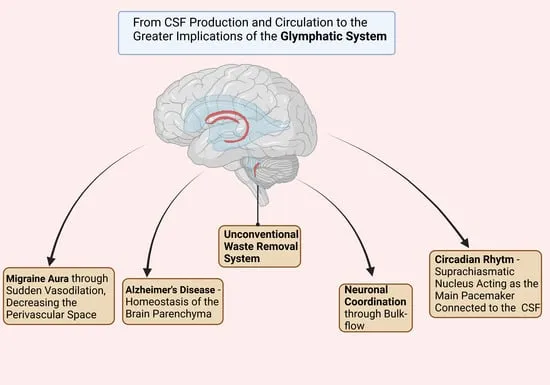
Photo: brain neuroscience recovery glymphatic system illustration, via pub.mdpi-res.com
Ask most Americans what the brain needs to recover, and the answer comes quickly: sleep. Eight hours. No screens. Maybe a white noise machine. Sleep science has dominated the wellness conversation for the better part of a decade, and for good reason—the evidence for its cognitive importance is overwhelming. Yet a quieter body of research is beginning to complicate that picture in productive ways. Neuroscientists studying recovery are finding that sleep, while irreplaceable, is only one component of a larger restoration system. The brain, it turns out, requires a more comprehensive maintenance schedule than any single nightly window can provide.
The Glymphatic System: Your Brain's After-Hours Cleaning Crew
To understand why recovery extends beyond sleep, it helps to understand what the brain is actually doing during its downtime. In 2013, researchers at the University of Rochester made a landmark discovery: the brain operates a dedicated waste-clearance network now called the glymphatic system. During sleep—particularly slow-wave, deep sleep—cerebrospinal fluid surges through channels surrounding blood vessels, flushing out metabolic byproducts including amyloid-beta and tau proteins, both implicated in Alzheimer's disease.
This discovery reframed sleep from a passive state of unconsciousness into an active biological necessity. However, subsequent research has revealed nuance that often goes unreported in popular wellness media. Glymphatic activity, while peaking during sleep, is not entirely absent during wakefulness. Certain postures, hydration levels, and even breathing patterns influence how efficiently this system operates throughout the day. Studies published in The Journal of Neuroscience have demonstrated that lateral (side) sleeping positions enhance glymphatic clearance compared to sleeping on one's back or stomach—a detail that speaks to how even minor behavioral choices shape neurological housekeeping.
The practical implication: optimizing glymphatic function is a 24-hour project, not merely a nocturnal one.
Deliberate Rest: The Undervalued Recovery Protocol
One of the most consistent findings in cognitive neuroscience over the past fifteen years concerns what researchers call "deliberate rest"—wakeful, intentional periods of low stimulation that allow the brain to consolidate recent experiences. This is distinct from sleep and distinct from distraction. It looks, from the outside, like doing nothing. Internally, however, the brain is extraordinarily active.
During deliberate rest, the default mode network (DMN)—a constellation of brain regions associated with introspection, memory consolidation, and creative insight—activates robustly. Studies from the Weizmann Institute and replicated across multiple U.S. university labs have shown that participants who rested quietly for ten to fifteen minutes after learning new material retained significantly more information than those who immediately moved on to another task. The rest period appears to give the hippocampus an opportunity to replay and encode fresh memories before interference from new stimuli can degrade them.
Neuroscientists who study this phenomenon often practice what they preach. Many report deliberately scheduling brief, screen-free rest intervals between cognitively demanding tasks—not naps, but genuine disengagement. No podcasts, no scrolling, no passive television. Simply allowing the mind to wander without agenda.
Strategic Caffeine Timing: Working With Adenosine, Not Against It
Caffeine is the most widely consumed psychoactive substance in the United States, and most Americans use it in a way that inadvertently undermines the very recovery they are trying to support. The neuroscience here is both elegant and counterintuitive.
Caffeine functions by blocking adenosine receptors in the brain. Adenosine is a byproduct of neural activity that accumulates throughout the day, progressively increasing the sensation of sleepiness—a process called sleep pressure. When caffeine occupies adenosine receptors, it temporarily masks this pressure without eliminating it. The adenosine continues to accumulate behind the blockade.
The critical insight from sleep researchers like Dr. Matthew Walker at UC Berkeley and Dr. Andrew Huberman at Stanford concerns timing. Consuming caffeine within the first 90 minutes of waking, when cortisol levels are naturally elevated and adenosine has not yet substantially built up, provides relatively modest benefit while potentially disrupting the natural hormonal arc of the morning. Delaying caffeine intake by 90 to 120 minutes after waking—allowing cortisol to peak and begin declining naturally—tends to produce more sustained alertness and a cleaner energy curve through the afternoon.
Equally important is the afternoon cutoff. Given caffeine's half-life of approximately five to seven hours, a 2:00 p.m. cup of coffee still leaves meaningful caffeine in the system at 9:00 p.m., subtly degrading the deep sleep quality that glymphatic clearance depends upon.
Non-Sleep Deep Rest and the Autonomic Reset
Emerging interest has surrounded a category of practices collectively referred to as non-sleep deep rest (NSDR). This umbrella term encompasses yoga nidra, body scan meditation, and certain forms of guided relaxation that bring the brain into a hypnagogic state—the threshold between wakefulness and sleep—without fully crossing into unconsciousness.
Research from Stanford's Human Performance Lab and related institutions suggests that even brief NSDR sessions of 20 minutes can restore dopamine levels in the striatum, replenish focus-related neurochemicals, and accelerate the recovery of cognitive performance following sleep deprivation. Crucially, these practices appear to shift the autonomic nervous system from sympathetic dominance (the alert, stress-responsive state) toward parasympathetic activation, creating physiological conditions conducive to neural repair and memory consolidation.
For cognitively demanding professionals—surgeons, researchers, attorneys, engineers—NSDR is increasingly being discussed not as an indulgence but as a performance maintenance tool comparable in legitimacy to physical recovery protocols used by elite athletes.
Exercise Timing and the BDNF Window
Physical exercise remains one of the most robustly supported interventions for brain health in the scientific literature, largely due to its stimulation of brain-derived neurotrophic factor (BDNF)—a protein that supports the growth, maintenance, and plasticity of neurons. What is less commonly discussed is how the timing of exercise relative to learning can dramatically influence its cognitive benefit.
Studies from the Danish research group of Wendy Suzuki and others have found that aerobic exercise performed immediately before or within a few hours after a learning session significantly enhances memory encoding compared to exercise performed at unrelated times. The post-exercise elevation in BDNF appears to prime the hippocampus for synaptic strengthening, essentially making the brain more receptive to consolidating new information.
This suggests that exercise is not simply a background health behavior but an active variable in the brain's recovery and learning cycle—one that can be deliberately positioned for maximum neurological return.
Building a Recovery Architecture
The convergence of these findings points toward a more sophisticated framework for cognitive recovery than sleep hygiene alone can provide. Rather than treating the brain's restoration as a single nightly event, neuroscience supports a distributed approach: deliberate rest intervals during the day, strategic caffeine timing, NSDR sessions during energy valleys, appropriately timed exercise, and consistent attention to the conditions that support glymphatic clearance around the clock.
None of these practices requires expensive equipment or radical lifestyle overhaul. Most can be integrated incrementally into existing routines. What they do require is an understanding that the brain is a metabolically demanding organ operating within a continuous biological rhythm—one that rewards consistent, evidence-informed care at every hour, not just the ones spent in bed.